
For warehouse, depot and distribution teams
Warehouse & Logistics LED Lighting in Scotland
Plan high-bay, aisle, loading-bay and control upgrades around racking, vehicle movements and live shifts. WB Electrical helps define the lighting package, phase the work and leave a maintainable handover.
From our Larkhall base, we support warehouses and distribution sites across Glasgow, Lanarkshire and the Central Belt. Larger logistics facilities and Scottish portfolios are considered by agreement.

Lighting planned around racking, movement, access and the hours your site actually operates.
Different zones need different lighting decisions
Lighting that fits how your warehouse works
A racked aisle, an open dispatch floor and a loading bay should not be treated as one identical lighting zone. Start with the task, racking, movement routes, mounting height, daylight and operating pattern in each area.

Racked aisles and pick faces
Review aisle width, rack height, pick locations, labels and existing fittings together. The lighting needs to reach the working plane and vertical rack faces without creating avoidable glare or deep shadow along the route.

Open floors, packing and dispatch
Packing benches, marshalling areas, conveyors and open storage floors can need different coverage from narrow aisles. Layout, moving equipment, task detail and the position of stock all affect the useful lighting arrangement.

Loading bays, yards and transition areas
Shutter doors, loading bays, pedestrian routes and external yards need particular attention where vehicles and people mix. Indoor and outdoor brightness changes, obstructions and glare can all affect visibility around the operating area.
Choose the lighting service that solves the actual problem
Bring the right lighting work into one warehouse plan
Warehouse projects can combine several LED Lighting components, but each solves a different need. We can help define the package without turning every high-bay replacement into an unnecessarily complex controls or refurbishment project.
Upgrade ageing high-bay or aisle lighting
For fluorescent, discharge, legacy LED or mixed lighting where the fittings, layout or light quality no longer suit the warehouse operation.
A lighting upgrade can review existing fittings, mounting heights, aisle geometry, controls, access and the electrical work needed before deciding whether repair, partial renewal or wider replacement is appropriate.

Add practical controls by zone
For racking aisles, stores, welfare areas, plant spaces and other zones that are not occupied continuously or have predictable operating patterns.
Occupancy sensing, daylight response, schedules, dimming and zoning can be considered where they suit the warehouse. More advanced control systems need their interfaces, detection behaviour and responsibilities agreed for the actual site.

Keep emergency lighting separate and coordinated
For escape routes, open areas, final exits and other locations covered by the agreed emergency-lighting design and fire-safety information.
New emergency fittings, alterations and remedial installation work can be coordinated with warehouse lighting changes, while routine emergency-lighting testing remains a separate Testing & Inspection service.
Keep high-level and external lighting maintainable
Lighting maintenance and repairs can deal with high-bay faults, failed drivers, sensors and recurring dark areas after handover. For loading approaches, yards and perimeter areas, see external and security lighting.
During racking changes, fit-outs or staged refurbishment, temporary lighting can support working areas while the permanent scheme is unavailable or incomplete.
Racking, traffic and a workable installation window
Plan the lighting work around stock, vehicles and live shifts

Lighting work often happens above active aisles, stock and vehicle routes. Racking, high-level access, loading activity, shift patterns, permits and the electrical circuits serving each zone all affect how the programme should be organised.
01
Map the layout, heights and movement routes
Confirm the warehouse zones in scope, racking and aisle layout, mounting heights, mezzanines, conveyors, loading doors, pedestrian routes and vehicle movements. Record existing controls, daylight and the lighting complaints or objectives that prompted the project.
02
Coordinate access and the people affected
Agree the site contact, access equipment, aisle or work-area closures, traffic controls, permits, inductions and any isolation arrangements. Operations, racking, automation, fire, security or maintenance teams may need coordinating where their work interfaces with the lighting project.
03
Choose a realistic installation window
Phasing aisle by aisle, zone by zone or around quieter shifts can keep much of the site available. Evening or weekend working may be suitable where agreed, but loading, dispatch, vehicle access, isolation and safe separation from operations still need to be planned rather than assumed.
A fitting count alone is not a lighting design. Racking geometry, mounting height, task areas, stock, movement routes, controls and emergency-lighting interfaces can all change the right solution.
Need to keep dispatch moving? Discuss your warehouse lighting programme.
From installation to a system site teams can manage
Leave useful lighting records and clear control zones
A good handover should help the people running the warehouse understand what changed, how the controls work and what still needs attention. Agree useful aisle, bay, zone or asset references before installation begins.
For each completed zone
- A clear aisle, bay, floor or zone reference and the agreed lighting scope.
- Relevant electrical inspection, testing and commissioning records for the work completed.
- Control settings, sensor zones or user instructions where these form part of the project.
- Outstanding defects, exclusions and any separate follow-on recommendations.
Across several buildings or depots
Use consistent aisle, bay, fitting or zone references and agreed control settings. This makes later fault finding, layout changes and planned maintenance easier than relying on a generic list of fittings with no location context.
The aim is a lighting handover that remains useful when racking moves, operational zones change or another contractor needs to understand what was installed.
When maintenance is the next need: recurring high-bay faults, failed drivers, sensors or damaged fittings can be handled through the lighting-maintenance route rather than opening a new upgrade project each time. Explore lighting maintenance and repairs.
Relevant experience in live warehouse and industrial environments
Lighting support around active manufacturing and warehousing
Bridon-Bekaert, Coatbridge and Grangemouth
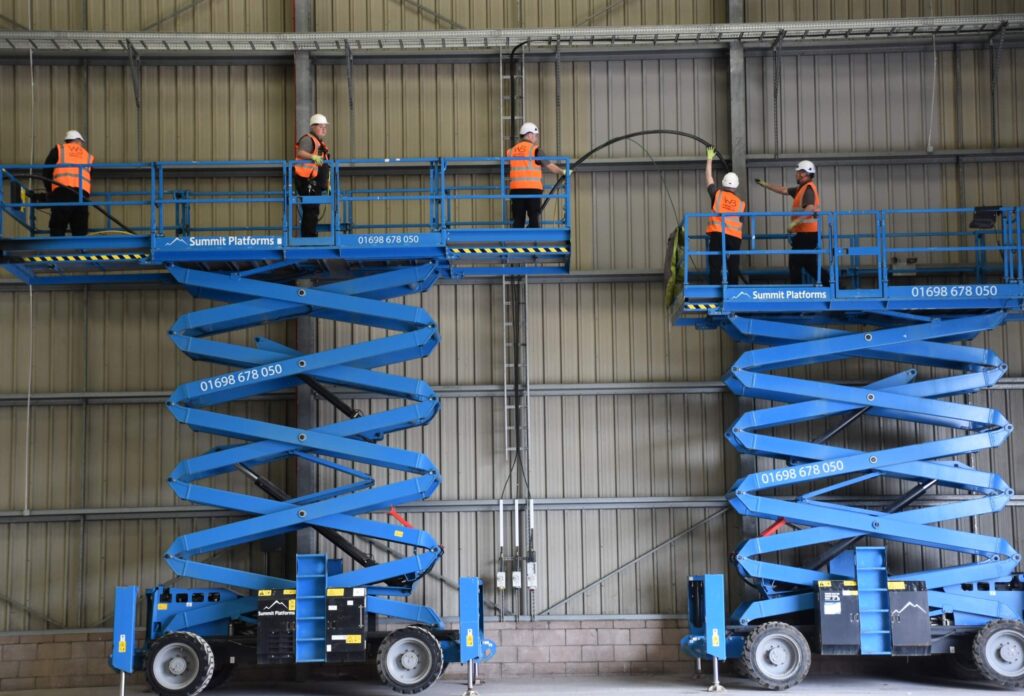
WB’s published Bridon-Bekaert case study records a relationship since 2014 across manufacturing and warehouse facilities in Coatbridge and Grangemouth, including operational maintenance, planned improvements and high-level work.
Recorded lighting work includes warehouse, production and high-level lighting maintenance, new lighting and sensors, emergency lighting, plus yard and security lighting. This is direct evidence of lighting work in industrial and warehouse environments; the accompanying project photograph shows high-level access during a later decommissioning phase rather than the lighting installation itself.
Supplier assurance
For contractor selection and procurement, review WB’s current accreditations and certificates. Tell us about framework, landlord, insurer or supplier requirements when enquiring.
Before you plan the upgrade
Warehouse and logistics lighting questions
Do we need to replace every high-bay fitting?
Not automatically. A survey can identify failed, unsuitable, inefficient or difficult-to-maintain fittings and whether some existing equipment can remain. The decision should also consider layout, controls, compatibility, access and the condition of the electrical installation.
What lighting level should a warehouse have?
There is not one useful figure for every warehouse area or task. BS EN 12464-1 covers the quantity and quality of lighting for indoor workplaces. The appropriate design depends on the work being done, the area, layout and visual conditions, so the requirement should be established for the actual site rather than copied from one generic number.
Why does vertical illumination matter in racking aisles?
Pickers and operators often need to read labels and identify stock on vertical rack faces, not only see the floor. Aisle geometry, luminaire position and light distribution therefore matter when the lighting proposal is developed.
Can warehouse lighting work be completed around live shifts?
Suitable work can often be phased by aisle, zone or working window, with evening or weekend activity considered where agreed. The final programme depends on access equipment, traffic management, stock, loading schedules, electrical isolation and safe separation from warehouse operations.
Do sensors and zoning make sense in every warehouse?
Not necessarily. Occupancy sensing, schedules, daylight response or local zoning can be useful where operating patterns vary, but detection, dimming behaviour and grouping should match the actual movement and tasks in each zone. More advanced controls need their interfaces and responsibilities agreed before installation.
Need wider electrical changes around racking, conveyors, loading equipment or charging infrastructure? See Warehouse & Logistics Electrical Services. For the wider lighting family, explore LED Lighting Solutions.
One warehouse, depot or multi-site portfolio
Plan lighting for your warehouse or logistics site
Tell us what is driving the project and what you already know about the site. We can identify whether the next step is a photo review, site survey, outline scope or quotation.
Useful information to send
- Company, site address and the warehouse areas involved.
- What is wrong now, or what you want the lighting to achieve.
- Racking layout, approximate fitting quantities, mounting heights, drawings or photographs, if available.
- Shift pattern, loading or dispatch times, traffic routes, permits and access restrictions.
- Any controls, emergency-lighting, external-lighting, refurbishment or multi-site requirements already known.
Exact fitting counts or drawings are not essential for the first enquiry. Mention photographs or existing information in the form; the WB team can confirm the most useful way to share them.
What affects the quotation?
Fitting quantities, mounting height, racking and aisle layout, access equipment, controls, emergency-lighting scope, working hours, electrical alterations, phasing and the number of visits can all affect cost.
Survey, design coordination, supply, installation, controls and handover will be scoped as applicable. Unknown existing conditions may need checking before a final installation price is confirmed.
Need wider fixed-wiring or compliance checks? See Warehouses & Logistics Testing. For wider electrical infrastructure, use Warehouse & Logistics Electrical Services.